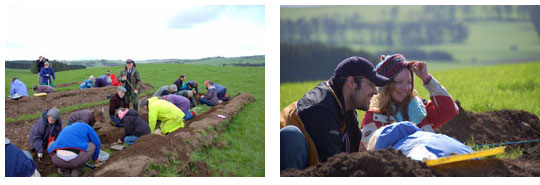
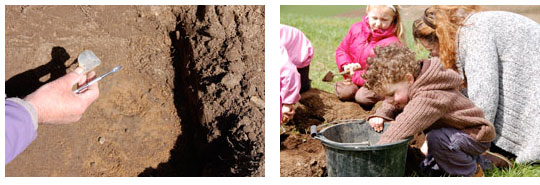
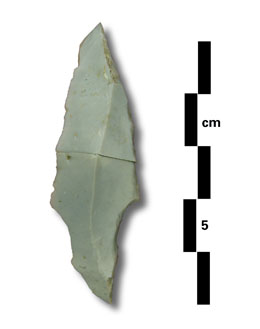
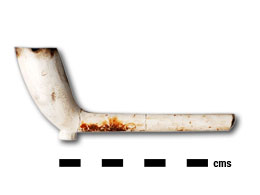
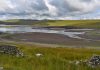
We’ve quickly leapt forward 20 miles and 5,000 years or so from Paleolithic Howburn to Mesolithic Daer. Our next Biggar! Dig is in the Daer Valley. Our clear felled forest walking has paid off with a potentially huge mesolithic area to be explored.
The forest walking at Daer has opened up new, previously unknown, areas of Mesolithic and Later Neolithic sites. Mainly following the contour of the lower hills around the Daer Valley – we’ve still to walk the tops of the hills where we hope to find more evidence of them. So far, in this area, Bronze Age house sites elude us, but you never know.
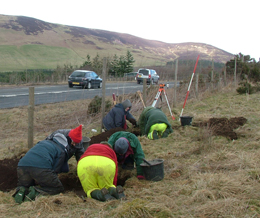
How do we know we’ve got such an expanse of occupation? Some of the finds from the fieldwalking include microliths – both flint and chert, cores, scrapers, pottery, fireplaces, cairns (potentially burial) and burnt mounds. These have been exposed in the trench digging process for the expansion of the tree plantation.
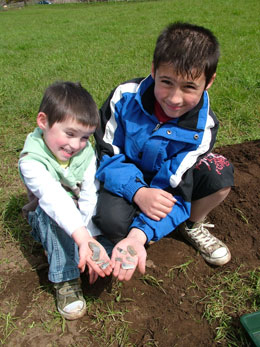
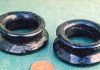
Microliths found on Sunday
More microliths and possible piercer found on Sunday
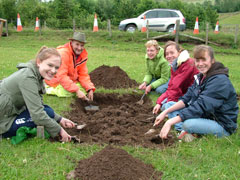
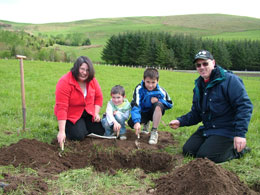
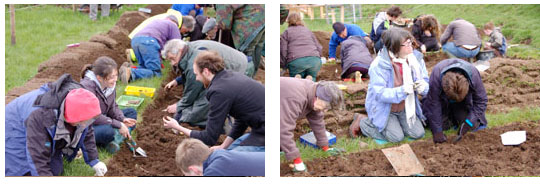
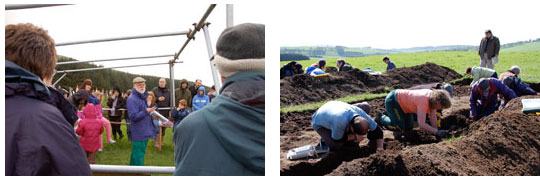
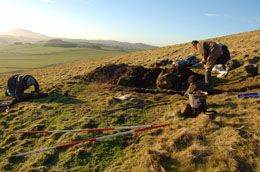
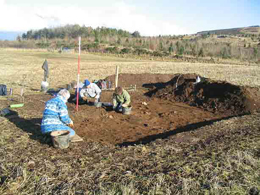
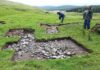
On Sunday we started the excavation in one area of lithic concentration. We had a great start finding several microliths and a possible piercer from less than 2 square metres (pictured). This dig will take some time and we are going to need lots of help so if you would like to come along and give us a hand, please use the contact form to get all the details.
It would be great to get as many volunteers as possible for this excavation and also to continue walking the area. The walking can be hard going as it’s mainly up and down hills, but it’s worth the effort to increase the potential of more Mesolithic and Late Neolithic sites. The sites for excavation are a short walk from the forestry access road.
We will be working on this site from Sunday 30 May for about 2 months (depending on the number of volunteers we get) – working Saturdays and Sundays. We will need people for fieldwalking and excavation so if you are interested, use our contact form to get in touch and let us know what you would like to volunteer for.
We will continue to keep the website up to date with what we find and how we are getting on and how the dig is progressing. So keep checking back with us and keep on top of the finds and progress. We have excavated at Daer Valley before and you can read more about that and the reservoir itself in the Clydesdale section of the current projects.
Map showing access from A702
Below are maps of the area
The site is situated within the forestry area of the Daer Valley. The road access is basic and a bit rough, there are locked gates to deter unauthorised access. It’s essential that you contact us to let us know if you are planning on coming along. This helps with all the administration and legal requirements as well. Do this by using the contact form and we will make sure that, if you are making your own way, that the road is open.
A point to note is that there are no facilities provided at this excavation site and it is very exposed– so make sure you get in touch to find out what you need to bring and get information on what is expected.
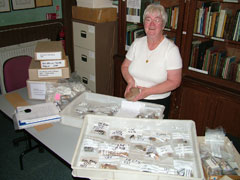
One box from Mr Dunlop’s collection – with a Late Neolithic oblique arrow, 2nd row, 3rd from the left.
A week in Biggar Archaeology – and what a week
It all began when Tam was asked by a lady in Peebles if he wanted to collect four boxes of flints she had in her possession, they were arrow heads and other tool types. When she mentioned the collector as a Mr Dunlop and that the items were neatly labelled with their dates of discovery, all being in the late 1800’s, Tam immediately knew part of their story. He was on her doorstep within the hour.
The museum already had two boxes of Mr Dunlop’s collection and it is known there were originally over twenty boxes, because he occasionally exhibited them at local events. Furthermore, in the museum archive there is a note book/diary left by Mr Dunlop who worked on local farms, mainly as a drystane dyker. In this fascinating manuscript he tells of the weather and seasons, how much he was paid for certain jobs and the working conditions which prevailed at the turn of the 20th century. He must have developed an eye for spotting stone tools which he collected on his travels round local farms, and meticulously stored them in little glass topped trays (actually sweetie boxes). No attempt was made to describe the items which include leaf, transverse, oblique and barb and tang arrow heads, microliths, scrapers and a range of tools such as knives and other retouched pieces. However, his collecting policy extended to purchasing foreign items as one tray has four large barbed points found in America.
Sandra finds a transverse ‘duck bill’ type arrow.
Pleased with the new acquisition for the museum and especially how easy it was come by, Tam took the boxes with him to show the field walkers who turned up over the weekend of 10/11th April. It was pointed out that one arrow in the boxes was a type not yet found by BAG on any of their projects; this was a Late Neolithic oblique arrow, often seen with one side extended further that the other to form a single barb and with a hollow base for hafting.
Work began on Saturday that weekend at the now famous Howburn Farm, near the village of Elsrickle, with two fields which had never been explored. Before lunchtime, one of the group; Brenda Dreghorn had found a flint arrow head – and incredibly it was a perfect oblique one, our first ever and now making No2 in the Biggar collections. Only a few random flint and chert flakes were found after that, but the team were overjoyed at this latest find.
The range of arrow found over the week
Sunday got off to a good start when Sandra Kelly found another Late Neolithic flint arrow, but this time it was a transverse or ‘duck bill’ type. These arrow types are increasingly being found by BAG on their annual walking and excavation projects. Next major event was a discrete scatter of chert Mesolithic cores and flakes which clearly indicates a camp site. A short time later yet another but larger collection of chert cores and flakes pointed to a second camp site and a tiny microlith helped with its interpretation. The excitement wasn’t yet over for in the last five minutes of work Tam came across another flint arrowhead and unbelievably it was another oblique one! Howburn came up trumps again as an amazing locality for Scottish pre history with three Late Neolithic arrow heads found in one weekend and two Mesolithic sites.
Barb and tang arrow picked up at the nearby farm of Biggarshields Mains
Only a few weeks ago Joyce Durham picked up an exquisite barb and tang arrow at the nearby farm of Biggarshields Mains and Tam followed this up on the same farm (different field) with an equally dainty flint leaf. It seems that BAG are on a roll as far as arrow heads are concerned and there are still many fields left to check out before summer, watch this space.
Five square metre pits were dug on the opposite side of the road from the Howburn Palaeolithic site to check if the site spread in that direction
No Palaeolithic flint was found but several sherds of Early Neolithic pottery, a piece of pitchstone and an axe flake were recovered, and these clearly show that the Neolithic material found in the main trench last year probably extends under the main road.
A few pieces of chert including a microlith indicate that the Mesolithic material also extends beneath the road. This will be the final fieldwork at Howburn, we now await with some excitement the results of the lithics expert and the work of the valley coring – watch this space.
Barb and Tang flint arrow
Fieldwalking continues each weekend but so far the results have been less than exciting. However, Joyce Durham was lucky to walk straight to this beautiful Barb and Tang flint arrow, found as a random find near Elsrickle. Although we are searching for concentrations of finds which will indicate a site, such objects make a days work worthwhile. Each year several such items are picked up adding to an ever increasing collection of flint and chert tools spanning all periods of Scottish pre history. Well done Joyce.
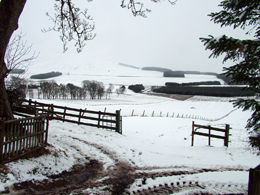
Snow covered Elsrickle field – the site for the coring sample
Some of us became mud larks last Saturday at Elsrickle when with colleagues from Stirling University we cored down into the valley floor beside the village.
The work is part of the study into the recently discovered site on Howburn Farm, where the earliest inhabitants of Scotland were camped on a seasonal basis and who lived as reindeer hunters 14,000 years ago
We are on the search for further evidence of this ancient time, and it is important to understand the environment in which our hunters and their prey lived in. The site is already established as being unique in Britain by the distinctive stone tools found there, and it is also the oldest known site for people in Scotland.
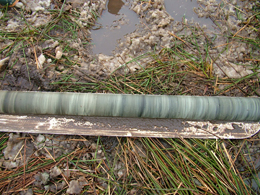
Section of core sample.
Richard Tipping of Stirling University continues the story, “We will be able to demonstrate the range of plants which grew in the valley at this remote time by identifying pollen in the cores we have retrieved from a bog on Elsrickle Mains Farm. The bog would have been a loch between our two last ice ages, and after the last one. It may be possible to date the events by studying the layers of mud which silted up the loch; this is the first time such work has been done in southern Scotland and it has us all excited by the possibilities”.
The story of the Howburn hunters is only just beginning as the finds collection is now with specialists who will examine them in great detail. Later this year when we have the results of these two latest studies, the story will move forward, however, every answer poses another question and this story will run for years to come. Basically we have just turned the page on a new chapter of the history of Scotland; there will be many more pages to come.
One thing seems certain; Elsrickle is set to become a famous name in archaeological and botanical terms. The latest aspects of the project are to be funded by Historic Scotland who has recognised the incredible importance of the discovery.
Labratory analysis of the sediments from the Priest’s Well Basin, Elsrickle
by Richard Tipping, 2 March 2010
A lot of work since November 2009 has shown that the floor of the valley below the Howburn archaeological site contains the sediments of not one, but two lakes. A large pro-glacial lake, so called because it formed in front (pro-) of a glacier, filled the valley as far as the archeological site at one time during deglaciation. This has been christened ‘Lake Howburn’. A second, much smaller lake survived the sudden drainage of ‘Lake Howburn’, as the ice-dam collapsed. This is preserved at the foot of the slope below Elsrickle, and has been called the Priest’s Well Basin. It was the sediment in the Priest’s Well that we sampled on a snowy day in late February 2010.
Since then, Lucy Verrill has been hard at work in the laboratories of the School of Biological & Environmental Sciences. A detailed description of the cores was made. Broadly, there were five different units. In stratigraphic order they are:
7.00-8.49m: weakly laminated to structureless clay with silt
8.49-8.60m: slightly organic silt
8.60-8.74m: laminated silts and clays.
In detail, the sediment units are highly complex, and the full description takes up 4 pages of single-spaced A4 paper. Figure 1 is a crude scan of the sediment stratigraphy, but it gives some impression of this complexity.
Figure 1. Sediment stratigraphy and simple geochemistry of sediments at Borehole 50, Priest’s Well.
The first things we needed to define were the physical characteristics of the sediment. This is simpler than it sounds. Lucy recorded the moisture content of sediments by noting the weight lost after oven-drying; the carbon content by noting the weight of the same sediment after burning it at 550ºC; and carbonate content by burning what was left at an even higher temperature, 950 ºC. By measuring carbon and carbonate contents, what remains after furnacing is the silica content. Lucy did these analyses for contiguous 1.0cm samples between 8.74 and 4.54m depth. The results are also shown on Figure 1. The broad divisions of the sediments outlined above are clear. High carbon and carbonate contents indicate warm temperatures. But Figure 1 also indicates the many short-lived fluctuations in sediment composition, particularly above 7.00m depth. Changes in sediment composition are usually caused by significant environmental changes, whether they be in the climate, lake level, soil erosion or the development of ecosystems, either in the catchment or in the lake. Given this, it seems clear that the sediment accumulating in the Priest’s Well Basin were very sensitive to these changes, and is a most exciting record.
To find out how old the sediments are, we used pollen analysis, because the high carbonate content of the lake sediments above 7.00m depth would distort any attempt at radiocarbon dating.
From these, it looks very much as if the organic-rich sediments above 7.00m depth are dated to the earliest part of the present interglacial, the Holocene Epoch. We might expect the change at 7.00m depth to date to around 11700 years ago. In fact, these sediments accumulated very rapidly, because even at 4.50m depth we have not seen much pollen of hazel (Corylus), which migrated to the region around 10 500 years ago (Figure 2).
Figure 2. Pollen diagram
The boundary at 7.00m depth marks the end of the last glacial phase in Scotland, called the Loch Lomond Stadial. Figure 1 suggests the change from glacial to interglacial climate at 7.00m depth happened very rapidly. In the Greenland ice sheet, this event is known to have happened over a few decades at most.
We could not extract pollen from the clay sediment below 7.00m depth, probably because sediment accumulated so fast that the concentrations of pollen became very diluted, but we think the inorganic clay between 7.00m and 8.49m depth must date to the c. 1200 years of the Loch Lomond Stadial. There would be little enough pollen around the Priest’s Well then, in an arctic climate too harsh for any plants save sedges, grasses and herbs. In this phase, small glaciers developed high in the Moffat Hills, above Carrifrans and Grey Mare’s Tail, but not around Elsrickle, which currently makes the laminations often recorded in this in the clay a bit of a puzzle, because these laminations are often associated with pro-glacial lakes.
At the bottom of our core, between 8.49 and 8.60m depth, we found the pollen of trees like birch (Betula) and tall shrubs like juniper (Juniperus), together with grasses and heathers like crowberry, in a sediment with organic carbon contents of around 7%. This should make this sediment unit belong to a very warm phase before the Loch Lomond Stadial, the Windermere Interstadial, which lasted for just over 1000 years: we have only just realised that we need to sample sediment deeper than 8.74m now, to find out what is beneath this unit. But this warm period was the one when our hunter-gatherers were living at the other end of the valley. At the moment, it seems safest to think that the only open water in the valley at this time was at the ‘wrong’ end of the valley, at Elsrickle. Maybe other camps still lie to be discovered around the Priest’s Well?
But we still have lots of puzzles. Most sediments below 7.00m depth are not only entirely inorganic, but also have no carbonate content. This is a puzzle because carbonate probably came into the basin from the weathered rock and soil around the Priest’s Well as soon as temperatures rose at the start of the Holocene. But if the valley was ice-free in the Windermere Interstadial, carbonate should also appear between 8.49 and 8.74m depth – but it doesn’t. Fortunately, because these sediments are free of carbonate, organic matter should yield good radiocarbon dates. There is precious little organic matter to date, it appears from Figure 1, but one of the most exciting discoveries in the coring programme since November 2009 has been that very delicate, very fragile mats of moss stems, almost certainly in situ and flourishing in summer-warmed shallow water, can be found in these inorganic sediments, even the laminated sediments formed in pro-glacial ‘Lake Howburn’. The next development in our story will come from finding out the ages of these moss stems.
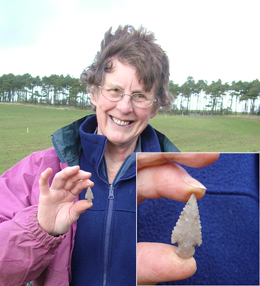
Chert arrow head found in clear felled forestry site at Fruid in 2008. The grin – because it’s my first arrow head.
The Biggar Archaeology Group is calling for voluntary fieldworkers for 2010. If one of your new year resolutions was to try something different or learn something new, or even to revisit old hobbies or interests then why not come along and give it a try.
We are out almost every weekend when weather permits and in the summer months we are often out in the evening. All work is within 30-40 miles of Biggar, and we have volunteers coming from Edinburgh and Glasgow as well as more local areas.
We have a lot of planned work over the coming year and would like to encourage along some new faces. The work covers three main areas of our annual programme.
This first one is to walk over areas of clear felled forestry around the Daer Valley in the hope of finding four main types of unrecorded sites:
Mesolithic camps sites
Bronze Age burnt mounds
Bronze Age house sites, and
Bronze Age burial sites.
All of which have been found by BAG in forests in previous years.
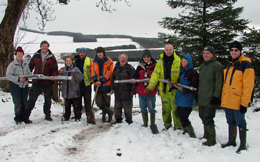
Volunteers fieldwalking as part of the Pre-History North of Biggar Project.Surveying among the felled tree stumps can be an arduous task – but it is worth it (see grin above!).
Secondly, there is a large arable field walking programme to be sustained and each year some very nice discoveries are made this way. The final area where we may need help is in our reservoir projects, if as we all hope, 2010 is a good summer, then the water levels will drop and further archaeological sites and finds will be there to be found.
Fruid reservoir excavation of a Bronze Age house site in 2008.
This is an excellent opportunity for amateurs and professionals alike and if you have never done such work, it can be a very rewarding and educational experience.
Contact us in the first instance if you are interested and we will supply details of how each aspect is operated, remember, it is only weekend and summer evening work.
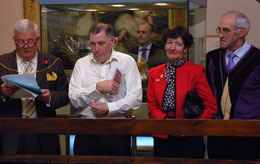
Pictured from left to right – Provost Russell McLeary, Tam Ward and Mr & Mrs Barrie.
The Biggar Archaeology Group held a celebration party at the Moat Park Heritage Centre on Monday evening, as a thank you to all of the people who helped on their recent excavation at Howburn Farm.
The party was hosted by South Lanarkshire Council and Provost Russell McLeary spoke to an audience of about ninety people of the great significance of having the oldest known archaeology site right here in South Lanarkshire. He warmly congratulated the voluntary group and all of the people who rallied round to help with this extraordinary and unique project which has pushed the history of Scotland back by over 3000 years.
Tam Ward, the leader of the group also heaped praise on the amateur archaeologists, many of them children, for their magnificent effort in what was a three month long campaign to prove that reindeer hunters had crossed the area of the present North Sea (on foot), having come from somewhere around Denmark or North Germany, to arrive at Howburn where they made successive camp sites over the years. Tam also thanked farmers Ann and Graham Barrie for their co operation in allowing the work to be done in their field and presented them with a framed picture of the exhibition.
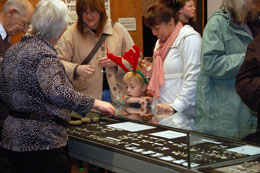
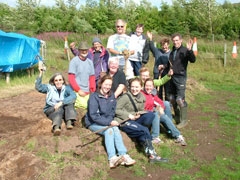
Volunteers and Reindeers enjoying the festivities.
The party was also an opportunity for many of the diggers to see their finds and those of others on display and learn exactly what they have achieved. The exhibition on the project will remain for the whole of 2010 in the Moat Park; however, it will be moved lock stock and barrel to the Scottish Parliament in January for one week.
Santa’s little reindeer were in attendance as all of the children were presented with set of antlers for the occasion which was enjoyed by all.
Now comes the serious behind the scenes study and research into the finds, the story has only just began, as the thousands of rare flints are examined more information will creep out and throw further light on Scotland’s First People.
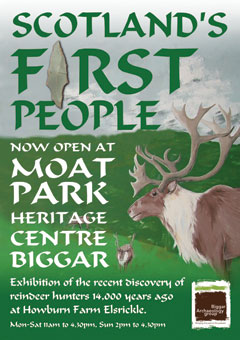
We have completed an exhibition in the Moat Park Heritage Centre in Biggar. This exhibition showcases the finds and the story of the earliest people of Scotland – the Reindeer Hunters from 14,000 years ago.
The story is being told with maps, photos and of course a very nice selection of the finds. The finds on display are only a small selection of the ones found. So anyone who sees them can appreciate the tremendous quality as well as quantity.
On show are the distinctive flint tools found on the site that identified the 14,000 year old reindeer hunters.
Walking from Denmark, Holland and Germany over what is now the North Sea and following the huge herds of migrating reindeer. The hunters set up their camps along the way and Howburn was one of these. Their camps are likely to have been used on several occasions, which accounts for the many flint tools left behind.
Within this one field at Howburn, on the outskirts of Biggar evidence from every pre-historic period has been found. This can be seen from the lithic on display – found by field walking and excavation.
Howburn pre-history:
an Iron Age pit, dated to AD140;
a Bronze Age arrowhead;
Neolithic pottery as well as arrowheads and other distinctly neolithic tools;
Mesolithic tools including microliths; and
The Late Upper Paleolithic tools.
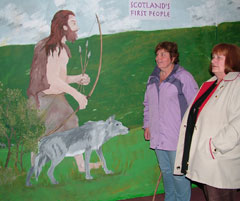
Visitors viewing the illustrated panels
Other sites like Howburn
The only other sites like this one are found in Europe. Sites as old and even older are found in England, but these were occupied by different people to those that came to Howburn, they are identified by their different types of flint tools.
Ice Ages
There have been numerous Ice Ages but the last one in the northern hemisphere ended around 15,000 years ago. At that time most of Britain and Europe were under a thick sheet of ice, in some places more than a mile deep. About a thousand years later the ice receded due to rapid climatic warming. Very quickly vegetation established itself and with vegetation came animals – horse, reindeer and in some places woolly mammoth and many other species. The nomadic hunters followed their prey.
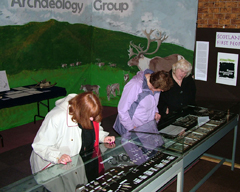
Visitors viewing the lithics at the exhibit, Moat Park Heritage Centre, Biggar
The warmer climate only lasted a few centuries. A mini ice age returned to Scotland, known as the Loch Lomond Re-Advance.
14,000 years ago the North Sea was dry land, joining Britain to Holland and Denmark as vast quantities of water were locked up in the receding ice sheets. It was only later when the ice age was completely over, the sea levels rose, creating Britain and Ireland as islands.
The dig is over and what a result we have achieved.
Proof positive is now available for Scotland’s earliest known community in the Hamburgian period of the Late Upper Palaeolithic; this is in the form of dozens of diagnostic flint tools.
The Keddie family all the way from The Netherlands show off their finds.
For BAG, another very important aspect of this project has been the formation of a new community of voluntary archaeologists. At the outset we realised we needed help and so we advertised and invited the world to participate in what was a unique opportunity to literally touch the past of the most ancient inhabitants of Scotland, and touch it they did, from children to adults, everyone found some of the ancient flint and some of the luckier ones handled tools such as tanged points, long and short end scrapers, burins, piercers, cores and much more for the first time since the end of the last ice age.
Visitors from Canada enjoy Scottish archaeology with our own Alick Walkinshaw.
Strangely we had no professional archaeologists along to help and very few university students, a rather missed opportunity we believe, however, over one hundred and fifty individuals did come, some for a single visit while others came on repeated occasions. We have had people from Newcastle, Carlisle, Glasgow, Edinburgh and just about everywhere in between. Visitors including children from Bosnia, Canada and The Netherlands have helped with excavation. Many new friends have been made in the process, we are indebted to them all.
Denny Dudds sorting the last of the Howburn finds ready for specialists work on them.
What now?
Well, things don’t just stop at Biggar Archaeology, we are already well on the way with a temporary display of the Howburn finds, this will be in the Moat Park Heritage Centre in Biggar. Only a tiny selection can be viewed but these will give a good idea of what the project was all about. For some reason this will be the only display of such material in Scotland and the exhibition will be ready in a few weeks. We will announce its opening on the website.
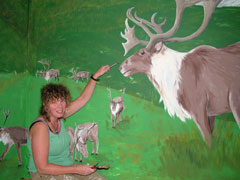
Sandra Kelly puts the finishing touches to a reindeer display in the Moat Park Heritage Centre.
An interim fieldwork report is in prep and will appear on this web site soon and we shall also be including a picture gallery of the project and some of the finds for your interest.
It only remains to thank everyone who participated in any way towards the great success of this project, without you it could not have happened, well done and congratulations.
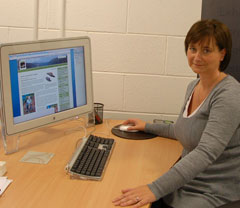
Jacquie updating the BAG web site which she manages.
Two tanged points found in the same 1 metre section. We are not washing any finds found in situ – these will then be available to test for pitch residue.
What a weekend! (our last, but one)…
Tang points, scrapers, cores and lots more coming out the ground so fast we could hardly keep up with them. However, even though we know there are lots more of these fantastic finds, the decision has been taken to end the dig.
Next weekend will be the last and we will be opening up a series of trial pits around the site to establish the nature of the ground surrounding our two main trenches. When this is done we shall be able to assess the field in order to make a statement to lay the foundation for any future work – but not by us.
Valerie Ferguson shows two tanged points she found in the same metre grid
Alan Saville and Torben Ballin our lithic specialists have had a brief look at the finds – now back in the museum – and they were astounded by the quantity and quality of the Late Upper Palaeolithic artifacts.
We also had Clare Wilson, environmental scientist from Stirling University, out on site to look at the soil and till profiles in the trenches, we are glad to have her on the team and she will report soon on her findings. Of particular interest was how a lot of the Paleo lithic managed to migrate down into the till, sometimes to a depth of 300mm, we now understand this was due to the process of cryoturbation cause by freezing and thawing during the Loch Lomond Re Advance period.
Mark Callan of Biggar YAC shows a fine side scraper he found.
Only one more weekend remaining for fieldwork but we are already well on the way with a new display at the Moat Park Museum in Biggar to show off some of the finds and explain what the project has achieved. There will be more on that soon. We shall also be posting pics of some of the finds for your interest, so keep an eye on the website.
Rab and daughter Jennifer show off their all round retouched long scraper.
We are down to our final few weeks and…
The progress being made is fantastic, work at the original Trench is now complete with the final tally of probably five tanged points being found there, along with a large number of other tools mainly being long, end scrapers. Some evidence of actual knapping comes in the form of cores and a small quantity of tiny debitage. The trench is now re-instated and while we think we have found the main concentration of lithics in that area, clearly there are many still undiscovered pieces around it.
Janet Ward with her long, end scraper find. One of many found so far.
An interesting aspect of the work is that flint has migrated down into the till, sometimes up to 300mm below the plough soil. Normally of course there would be no archaeological interest below the ‘natural’; however what seems to have happened is that during the Loch Lomond Re-Advance period, and after the flint was left, the constant freezing and thawing of the ground allowed the lithics to work their way down. This process is cryoturbation (the action of freezing) and works in a similar way to bioturbation where worms, root systems and other burrowing animals can mix up soils and sub soils.
We reported finding ‘micro charcoal’ which we got a bit excited about, however the material may actually prove to be natural manganese deposits which can look very similar to charcoal.
Nevertheless, work on our Trench 2 beside the road has resumed with some very nice tools and flakes being found, including yet another tang point, another Neolithic leaf arrow head and a microlith. There cannot be many places where Upper Palaeolithic, Mesolithic and Neolithic artefacts can be found so casually on the same day.
A tanged point and scraper from the same grid.
We now have a large assemblage of lithic from the two trenches and the decision has been made to wind down the project. We are in no doubt we have proved the nature of the site and have succeeded in all of our aims and objectives. It is most likely that the field work will be completed by the beginning of August, so perhaps there will be another three weekend’s work to do.
The dig is proving to be a great success; with a further three tanged points being recovered.
First was by Mike Thornley last weekend, and his wife Sue found a nice end scraper in the same metre grid. Then Laura Conlon found one with only the tip missing but with a perfect tanged end and, finally, Fiona Christison got hers still lying in a sandy silt layer that rests upon the glacial till where it has been since the hunters left it. This one has only the end of the tang missing but with a perfect tip.
Fiona is one of the founders of the group and has been working on our archaeology for some thirty years now. So well done to the lucky three, however, everyone has now found some nice flint and numerous end scrapers have been retrieved along with countless broken blades and tools.
Fiona and our third tanged point.
We also started to get some debitage in situ in the sandy silt layer and numerous nice flints; most of this lithic is of a similar colour and may indicate a separate event or occasion on the site. Even more excitingly, we have managed to salvage some charcoal enriched soil patches sealed into the sandy silt layer. These were probably laid down with the flints. It does appear to be micro charcoal but if we can extract workable material, we may actually get a C14 date, the stuff of dreams.
A nice chert leaf arrowhead and a few microliths have also be recovered, re-enforcing the multi period nature of the site.
The work is now progressing into an area of deeper plough soil and the hope is that we will get more and more lithic in situ. However, the story changes constantly with the natural topography of the ground which undulates slightly between two minor summits in the field, where soil is shallow on the higher ground and deeper in the hollows.
Mike and Sue Thornely with their finds from last weekend.
Work continues at weekends and on some evenings during the week (check with us first to let us know your coming). Over the next couple of weeks there will be opportunities to dig during the week due to holidays.
There will be someone on site Mon, Tues and Wed each week for next two weeks as well as weekends, that is July 6, 7, 8, 13, 14 & 15. If you are interested in coming along during the week, let us know by either using the contact form or calling us at the museum on 01899 221050. If you are calling during the day please leave a message with your contact details – the messages are checked most evenings.
We have now completed 125 square metres beside the road, and have completed the first full 100metre block. The general picture is a scatter of flint and chert, the flint probably mostly being Upper Palaeolithic and the chert being Mesolithic. The tally for the 100m is around 240 flint including some fine tools and snapped tools, 1200 chert including at least one microlith, and thirteen pieces of Arran pitchstone
Irene and Leigh Ann show the tools they have found
We are convinced that the pitchstone is Early Neolithic based on numerous sites we have worked on (see the pitchstone report here), where it is found and dated in association with pottery and stone axe fragments. It was hardly surprising that in Grid No 1 four Early Neolithic sherds were found – and a piece of pitchstone, and in a nearby grid, a chunk of Langdale Pike (Group VI) was found.
Several flint tools have been found by the kids at the site of Trench No 1 and I am happy to announce that we have finally re-established the trench on the ground. This allows us to continue with that area where we know the main concentration lies, we shall resume work there on the weekend of 20th and 21st June to celebrate mid summer (if we ever get one!). During the first two weeks in July there will be the opportunity to work during the week as well as at the weekends. If you would like to come along then please get in touch by using the contact form we will be there most days so best to check.
John and Rosie Wells demonstrate Kite photgraphy in action.
It was particularly interesting to have John and Rosie Wells visit the site and to demonstrate pole and kite photography to us. If you want to know more about this fascinating way of recording, visit their web site at www.armadale.org.uk/kite.htm
In the meantime thanks to all who have helped, we have people from Newcastle, Carlisle, Glasgow and Edinburgh and lots of places in between, it has been a magnificent effort so far but please help us to complete this important work.
The Houston family, struck flint on their first ever dig. But of course this is not just any old flint, it is the oldest in Scotland.
The Houston family, struck flint on their first ever dig.
A very nice end scraper and several snapped tools were among the many pieces of Upper Palaeolithic flint found by the family. Mum said the boys (and dad) were thrilled to actually find such lovely pieces.
This was just what we were hopingto achieve, rarely if ever, will professional archaeologists ever get the chance to touch such rare pieces, and here is a local family engaging with their own archaeology.
Luke and Conner proudly show their discoveries.
The rest of the team are making good progress with several other Paleo tools being found including two scrapers and a curved back point, a patch of chert debitage from a Mesolithic napping site was also found turned up last week, in between showers.
More news soon.
We are still looking for volunteers every weekend. Contact us using the contact form or phone the Museum on 01899 221050. We are contactable most evenings at this number.
Unexpected and unique Upper Paleolithic finds recently discovered at Howburn Farm identifies this site as being the earliest in Scotland.
These finds have now been notified in The Journal of the Lithic Studies Society 28: 41 – 49.
The find is now considered so important in terms of the early settlement of Scotland that we are considering more work at the site beginning in May 2009. Originally found by field walking and then by excavation the flint assemblage is part of a larger multi period scatter of lithic and pottery over a discreet area of a field near Melbourne crossroads.
The field has produced a range of lithics spanning all pre-historic periods with chert and flint tools and debitage, also a few sherds of Early Neolithic pottery. However, the most surprising aspect of the collection is a significant quantity of Upper Palaeolithic flint tools and flakes, making this a unique site for Scotland. Tentative dating puts the site at c14,000 years ago immediately after the Main Ice Age and before the Loch Lomond Re-advance.
We are calling for voluntary diggers to work on this site, experienced and non experienced people will be welcome, and this will be a unique opportunity to excavate such a rare site in Britain.
We know that further finds are guaranteed since we shall be excavating the area of the surface scatter. Register your interest on our Contact Us page and come and dig the dream of finding the earliest people in Scotland.
Large Neolithic pottery sherd found at Carwood Excavations by one of our Young Archaeologists Club members.
Following on from fieldwalking in 2007, a repeat visit in 2008 to a field at Carwood Farm near Biggar produced more lithic finds. Additionally, this time, pottery and carbonised hazel nut shell was found.
Before the crop was sown a small excavation discovered pits containing pottery and lithic fragments including some of pitchstone. Excavation has resumed here over the winter of 2008/2009 to salvage whatever of the site had survived the ploughing.
It has become increasingly apparent that prehistoric sites of this kind are being lost annually in the arable lands of the Biggar area, as almost every year we find their remains dispersed in the freshly ploughed topsoil. As it is impossible for us to walk all the newly ploughed fields in our geographic area, it is safe to assume that such fragile sites are being destroyed annually without any record of their existence. If this situation applies throughout Scotland, and it is virtually certain that it does, then we are now losing our archaeological heritage at an ever-increasing rate. We believe this to be a matter of some urgency and should be considered at a national level.
Update February 2009
Bronze Age Beaker Pottery Sherd
Excavations have resumed before the next ploughing of the field. We have now discovered pits with Impressed and Grooved Ware Pottery, a type VI (Langdale Pike) stone axe and, curiously, sherds of at least two comb-decorated beakers.
Accordingly, it is now apparent that the site now represents the Neolithic and the Bronze Ages. Work will continue and it is hoped that we can complete the excavation of the entire site.
We are now able to show that settlements from c1600 to c1750 were becoming more materialistic than previously. Consumption of tobacco and wine is quite surprising for rural areas as is the quality of later ceramics including Delft and Staffordshire wares.
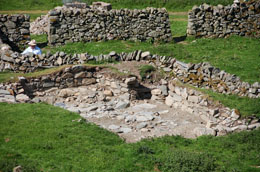
The buildings so far exposed indicate unusual types with thick non mortared walls and thinner mortared examples; however one building can only have been a tower or bastle house judging from its style and size.
Excavation of Bastle House remains
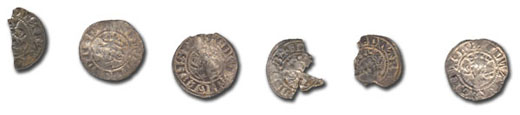
A chance find by metal detecting has been a small hoard of five Edward silver long cross pennies near the site. These are clearly not associated with the excavation evidence so far, and are most likely to have been lost in 1310 when Edward II was encamped at Biggar in October of that year. Several other small hoards of similar age have been found in the Upper Clyde area and this is the first for Tweeddale. It may be that Edward was sending out scouts or more likely envoys to test the loyalty or otherwise of local magnates.
Coin hoard found by metal detectorist close to the site
We are pleased to have received the Pitt Rivers Award for the second time as outright winners and to have also taken a second place in 2006. Our first Pitt Rivers Award was in 1996 for our Bastle Project. The following is taken from the British Archaeology Awards web site www.britarch.ac.uk/awards
The Pitt-Rivers Award for the Best Amateur or Independet Project goes to another first class and fascinating long-term project by a well-established group with a good track record. The work involved the comprehensive archaeological survey of over 400 square kilometres of Upper Tweeddale and the selective excavation of sites threatened by fluctuating reservoir water levels and forests and was carried out entirely by volunteers.
Fruid Reservoir excavations of the upper unenclosed platform
The objectives of the project were clear cut, the work was performed to a commendably high standard and, crucially, publication was timely, thorough and made readily available through an excellent web site. The panel was very happy to give the Pitt-Rivers Award for 2008 to Biggar Museum Archaeology Group.
We were especially please to learn that a motion was passed in the Scottish Parliament congratulating us on our win for Scotland and to receive congratulations from Linda Fabiani MSP, Aileen Campbell MSP and Robert Mundell MP.
There have been a number of awards won by Biggar Archaeology over the years, you can read more about them on our awards page.
Radiocarbon dates have now been received for a number of projects.
Fruid Reservoir
Excavated Pits at Fruid Reservoir
The Fruid Reservoir dates are 3100±35BP and 3150±35BP. This first of these was obtained from coppiced seven year old hazel used in the construction of the walls of one of the two houses investigated on the site. The second result was obtained from birch, also from a wall context in the other building. These dates make the site mid-Bronze Age and correspond well with the age of the palstave found in the earlier of the two buildings. The work at Fruid is complete and a report is in preparation. However, in 2009, with the aid of a grant from the Robert Kiln Trust, received as a consequence of our Pitt Rivers Award 2008, we will commission further environmental investigation of the abundant charcoal retrieved from numerous features in both buildings.
Biggar Gap Project dates
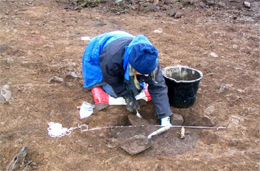
Excavating the chert
As part of the Biggar Gap Project our work on a chert quarry site near the village of Broughton has yielded a date of 5220±35BP. This was obtained from hazel charcoal, found, with oak, at the base of the 2m deep quarry face. Extraction had been done using stone pounders, several of which were found dispersed in the quarry infill. It is possible that fire-cracking was carried out to open up the chert layers but no conclusive evidence for this was found. (Report in prep).
Melbourne
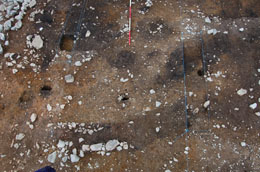
Excavation at Howburn
The fourth radiocarbon date we obtained this year is from a site near Melbourne crossroads. Dating was carried out on charcoal contained in one of a series of pits dug into glacial till and overlain by ploughsoil which had yielded a substantial lithic assemblage. The lithic material is being studied by Alan Saville of the National Museums and the results of his work will soon be available on this website.
As the date obtained was c.200 AD, it is evident that the pits have no connection with the lithic material recovered from the ploughsoil.
In the spring of 2023 the members of the Biggar Archaeology Group with the support of Peeblesshire Archaeological Society and Scottish Borders Council surveyed...