Looking down on the site from Doddin hill
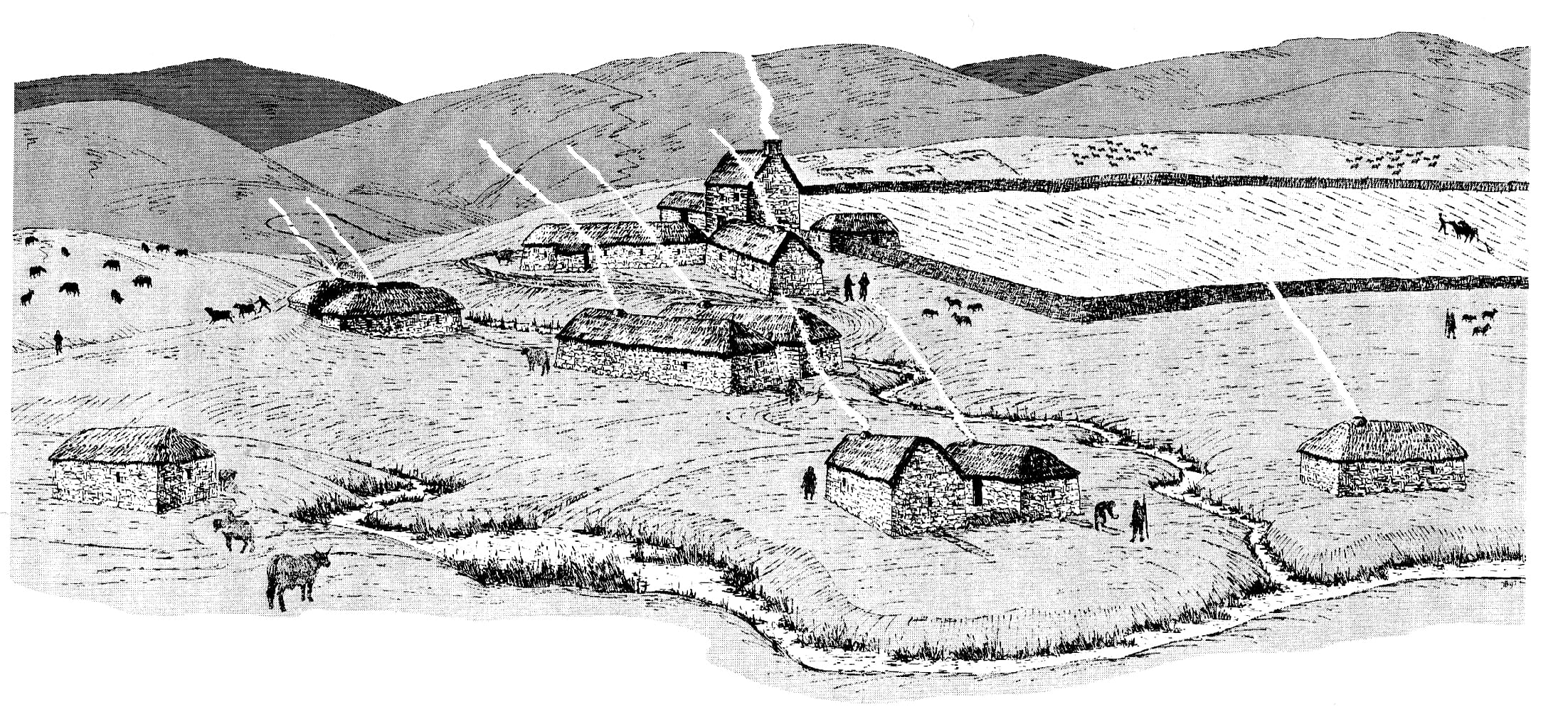
A Scottish upland fermtoun was a cluster of crude buildings surrounding a more substantial stone farmhouse belonging to a tenant farmer, sometimes known as a ‘bunnet laird’.
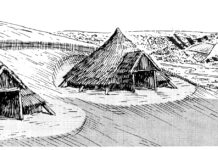
Often people and animals lived under the same roof with one end of the building occupied by cattle and the other by the people. Furniture as we know it was non-existent, people would sit and sleep on the floor, around a fire. The only opening in the house would be a low doorway and perhaps an occasional tiny unglazed window. It is thought that the houses, including the roofs, were built mostly of turf, but stone was used as the wall base and for the floor surfaces, including any drains. A few timber beams called crucks were used to form the roof which may have been thatched with straw or heather.
These house-byres would be occupied by farm workers called cottars whose houses were known as cot houses. At Glenochar the main farm house was a bastle, indicating that the laird had significant wealth – and wanted to keep it!
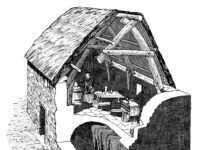
Bastles are the earliest stone houses to be built in a rural context in the south of Scotland. They were built around 1600 and are clearly constructed for defence, sometimes having fire proof slated roofs (but not here at Glenochar).
Confusion often exists between tower houses and bastle houses, the main difference being the height: where tower houses are generally three or more storeys high, the bastle is simply a single floor above the basement, which is often vaulted. In the past it has been the vaulted basement chamber which has wrongly been assumed to be the remains of a tower house.
Often the men who lived in tower houses owned the surrounding land, unlike the tenant farmer who paid a rent and could perhaps only afford a bastle for protection. Nevertheless, building such a substantial house 400 years ago was a proud statement of the occupier’s status and wealth.
The archaeologists have unravelled much of the development of the old farm of Glenochar by excavation and research. Many of the people who lived here during the 17th and 18th centuries are now known by name, mostly through their last wills and testaments, but also from names scratched on slates used as floor coverings. The artefacts left in the ground indicate the life styles of people enjoying luxury items like tobacco, wine and quality pottery. The people had money in their pockets too – and lost some of it!
The finds and the shape of the floors tell what each building was used for and often when it was used and altered. Strangely, little evidence is found for people living here during the 16th century or earlier, so it appears that the farm started its life around 1600 and it is known that the place was abandoned around 1750 to occupy the present modern farm of Glenochar.
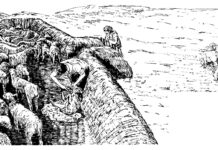
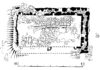
Importantly, the bastle story in Clydesdale is the best archaeological evidence of The Lowland Clearances. When you go through the excavations you will find the houses, the byres and the blacksmith’s workshop, as well as the bastle house. This artist’s impression is what the ‘fermtoun’ may have looked like from this viewpoint in the mid17th century, when most of the buildings were occupied.